A common barrier that prevents many marketing teams, both in-house and agency, from getting started with data analysis isn’t about the data itself. It’s about… systems thinking.
The belief that “you need a Data Analyst, a Data Warehouse, and professional dashboards to do proper analysis” has stopped many teams in their tracks. Just thinking about building a “proper” system before starting any analysis is enough to discourage most people. Or individually, many marketers wait until they’ve completed a full Data Analytics training program before getting hands-on. Yet the sudden exposure to a technically heavy skill set like Data Analytics becomes a barrier for many marketers, especially those without a technical background.
Many data analysis projects die at the tool implementation stage. The reason: the system is too heavy and too dependent on technical teams. Enterprise-grade analysis projects often require high costs. Meanwhile, marketing teams are always stretching their budgets to fund campaigns, making it a luxury to spend hundreds of millions on building a marketing analytics system, especially for small and medium businesses. Or there are projects that deliver beautiful dashboards, yet nobody actually uses them except… the boss. Gradually, the dashboard becomes just a place to “check results” rather than a decision-making tool.
The truth is: you don’t need a grandiose system or full Data Analytics capabilities to start applying data analysis to optimize your marketing activities. What you really need is just one good question, a few simple and even free tools you already have, like Google Sheets, Excel, Looker Studio, and a mindset flexible enough to learn, practice, and continuously adjust.
Agile Analytics: The solution for marketing data analysis. Small, fast, flexible.
Marketing data has a very different character from financial or operational data: it’s always dynamic and requires fast reactions. Therefore, applying Agile Analytics thinking to marketing data analysis isn’t just logical. It’s arguably the easiest and even free way to get started.
This thinking starts from a very simple premise: don’t wait until everything is ready! You can absolutely start with what you already have, a few Excel files from CRM, scattered advertising data, or a social media engagement summary. The important thing is asking a clear question: “What do we need to know to make better decisions?”
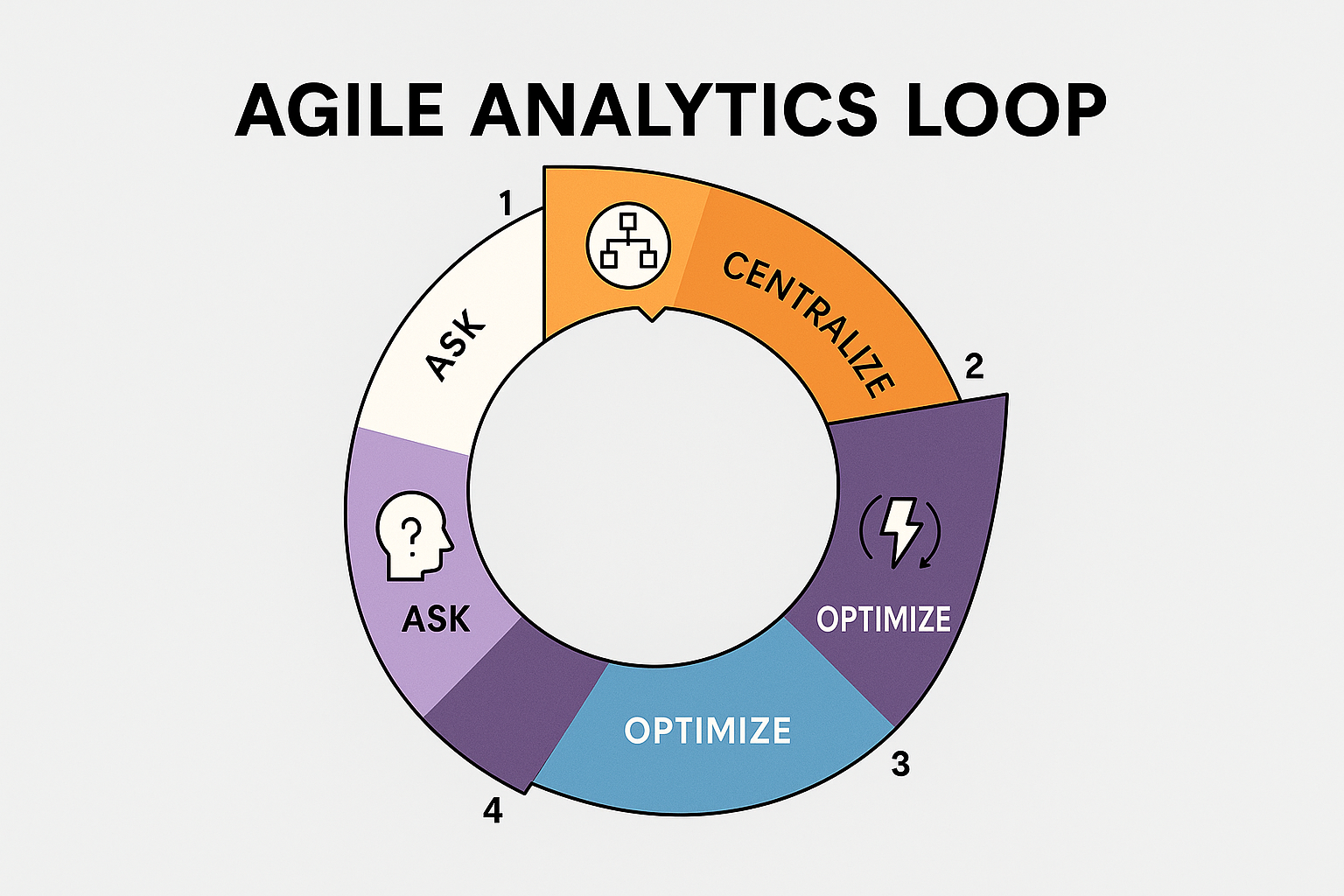
That process can be modeled into 5 simple steps:
(1) Ask: Identify 1 (just 1) priority question to help you make a better decision
(2) Centralize: Gather and connect available sources, tools, and team/individual skills
(3) Analyze: Process data and analyze, visualize the data
(4) Optimize: Analyze insights to derive specific optimization actions, identify areas needing deeper analysis, or data areas that need expansion for a more accurate view
(5) Iterate: Continue developing deeper analysis models by going back to step (1), but based on results from step (4)
Real-world example: Optimizing conversion by channel in real time
Suppose you’re facing this question:
“How do I track conversion changes across all channels from first touchpoint to closing the sale in real time and make decisions whenever needed without waiting for the agency’s weekly report?”
The context:
- CRM has data from Lead to Deal
- Agency is still running ads but hasn’t sent real-time reports
- You have Google Sheets and Looker Studio available
- Goal: near real-time data updates, clear view of conversion journey by channel
With an Agile mindset, you can act immediately:
(1) Ask: Question already defined
(2) Centralize: Ask the agency to export raw campaign data directly to Google Sheets. If they don’t have a system, use no-code tools to connect. Then sync CRM data to Google Sheets via free add-ons/connectors.
(3) Analyze: Use processing functions like IMPORTRANGE, QUERY, JOIN, ARRAYFORMULA to turn your spreadsheet into a “mini-database.” Then visualize it into charts and summary tables in Looker Studio or Google Sheets.
(4) Optimize: Now you don’t need to wait for the agency’s report. You can see conversions happening day by day, hour by hour. Most importantly, you can discover truly valuable insights and make decisions immediately:
- Channel A shows steady lead growth over 4 weeks but conversion rate isn’t improving. Is the problem lead quality or the sales process?
- Channel C has surging impressions but declining leads. Is the issue content, targeting, or tracking?
(5) Iterate: New questions emerge: Could we connect more data from CRM and chatbot? Can we measure specific customer segments? Should we use a more stable storage solution?
And so the next loop begins. With each iteration, you upgrade the system and your personal and team capabilities a little more. What matters isn’t what you already have, but that you’re ready to learn and continuously optimize. Gradually, with Agile Analytics thinking and capability, you’ll no longer feel like you’re “guessing by instinct.” Your team will take optimization actions that are logical, systematic, and repeatable.
Want to start without feeling overwhelmed?
If you feel you need a gentle starting roadmap that fits your current knowledge, tools, and team’s practical needs, subscribe to the “From Insights To Impacts” newsletter every Thursday!