
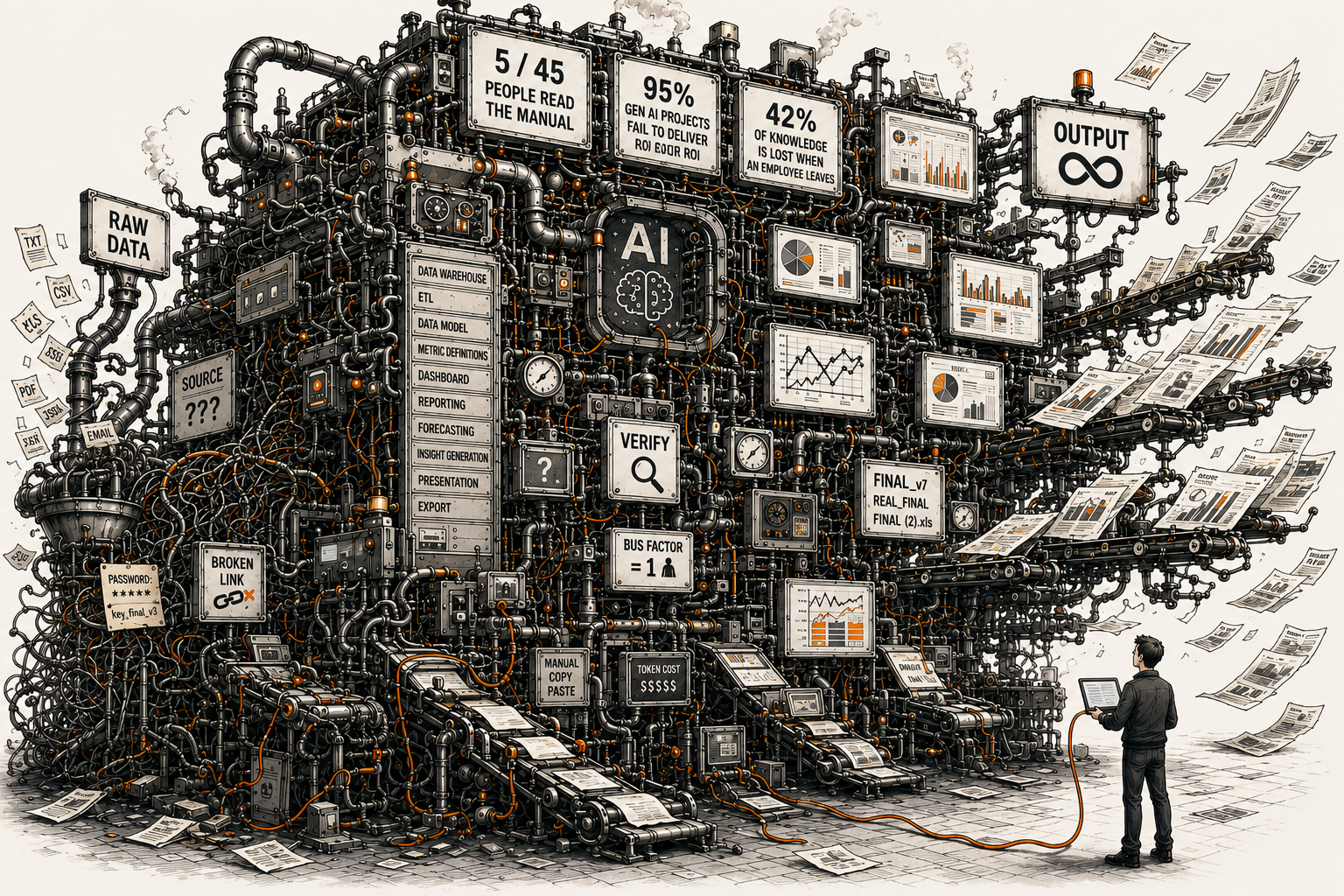
We are doing marketing in an era where publishing an analytical marketing report has become so easy that almost anyone can do it, while the ability to judge whether that report is right or wrong has become genuinely scarce. That gap has created a new “age of chaos” for marketers.
📌 Key Takeaways
- Marketing’s age of chaos comes from 3 diseases: high-interest knowledge debt from AI, Double Hallucination and Siloed Thinking.
- AI causes none of the three phenomena, but using AI to replace capability instead of building it is what creates the chaos, and AI only accelerates it, then sends the invoice.
- The sustainable way out: build capability across 3 layers (individual, team, and how you invest in AI), the opening move of the Marketing Intelligence capability journey in the articles to come.
Why is AI in marketing fueling the “age of chaos”?
From what I have observed, AI in marketing has pushed the cost of producing reports, dashboards and forecasts to nearly zero, without shipping the ability to verify them to the people who use it. The chaos shows up in 3 shapes:
- High-interest knowledge debt from AI: using AI to fill an expertise gap you never built.
- Double Hallucination: AI fabricates the numbers, and marketers who cannot verify them fabricate the insights on top.
- Siloed Thinking: a disease that predates AI, now accelerated and multiplied by it.
Observation 1. High-interest knowledge debt: when AI fills your analytics capability gap
Software engineers have a very useful concept called technical debt: when a feature has to ship fast, the team picks the quick, temporary solution over the right one that needs time. The code still runs, the product still ships, but the “debt” stays in the system and sooner or later gets repaid: in rework time, in performance, or at worst, in a crash.
Using AI to handle an expertise you do not really own is exactly that loan, at an extremely high interest rate.
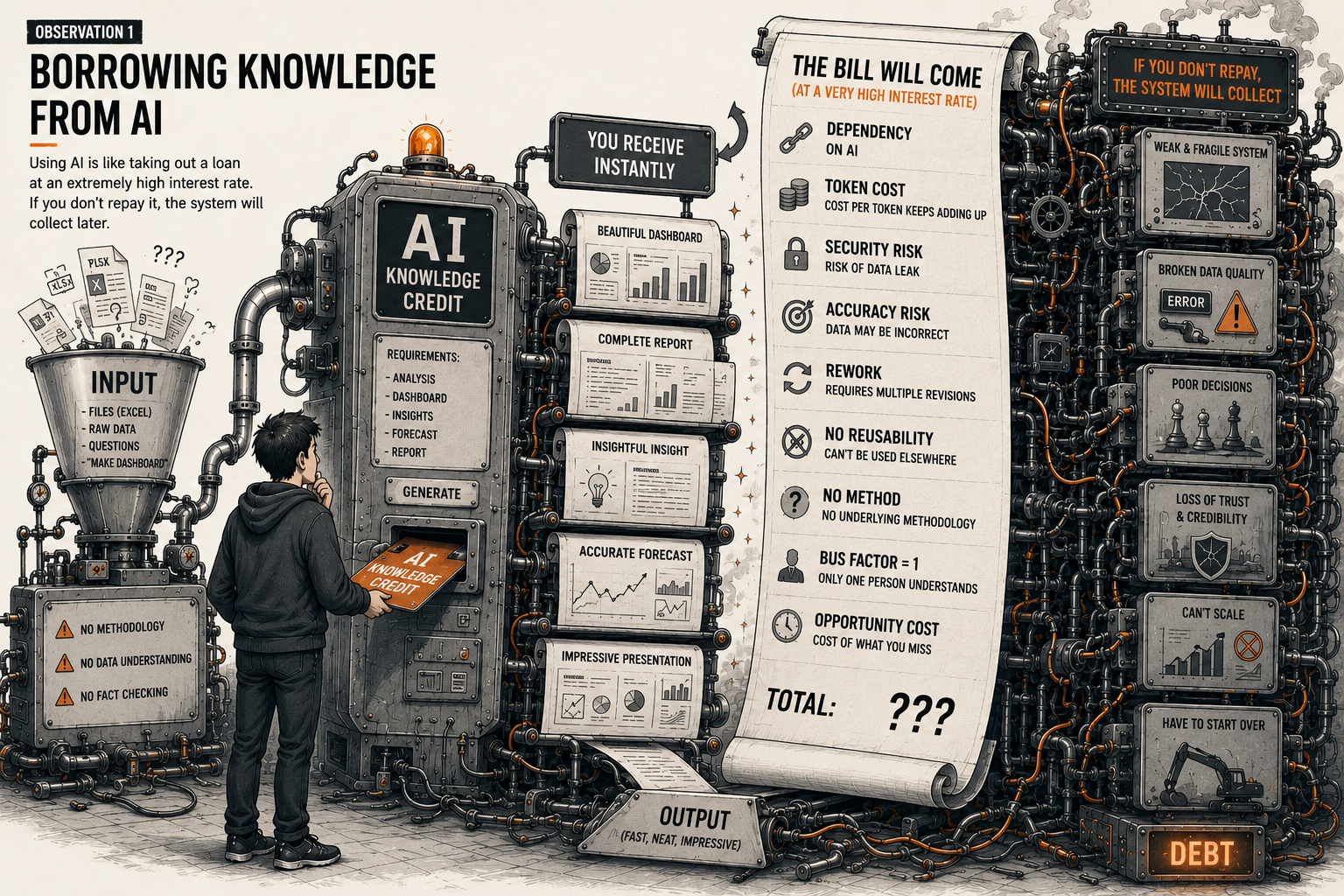
You may have heard of the story that went viral here in Vietnam recently: a CEO declared that with a $20-a-month AI tool he could replace developers on $1,200 salaries, and that from now on he could fix anything himself. A few days later, the community was flooded with screenshots of his AI-built html files leaking keys, usernames and database passwords. And it was not the first rerun of this show: some founders have proudly vibe-coded an app, then come back online shortly after to ask the internet how to recover a database that “somehow” got wiped clean.
In marketing, the more common and quieter version: throw an Excel file into AI with the magic spell “build me a dashboard”. The dashboard appears, gorgeous, with an html export ready to share. But every time you need to analyze deeper, none of the processed tables can be reused, so the tokens burn another round. I have seen reporting systems that would cost very little if built properly on a data warehouse and analytics services, yet in reality they sit inside the personal AI account of exactly one person, with total costs running 5 to 10 times higher. And that is before we talk about security, or the accuracy of numbers that are hard to verify because there is no proper pipeline.
And so every loan reaches its due date: borrow knowledge from AI at high interest and never repay it, and the interest compounds until… default.
Observation 2. Double Hallucination: how dangerous is AI hallucination in marketing analytics?
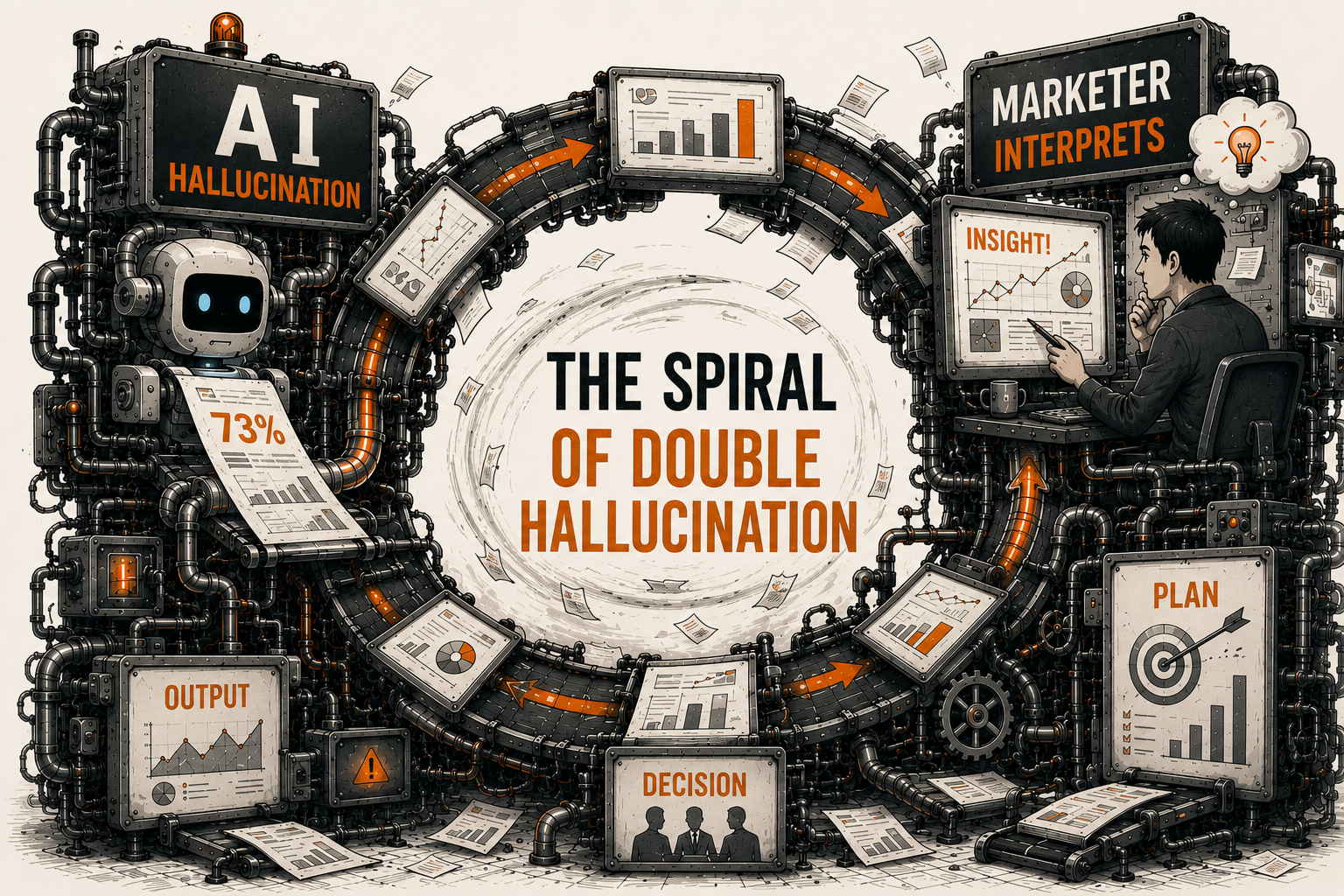
AI hallucination is the phenomenon of AI confidently producing information that does not exist: numbers, citations, even entire studies. But AI hallucination is only half of the problem. The other half sits on our side: when marketers lack the foundation to verify, we fabricate insights on top of it. I call that phenomenon Double Hallucination.

Do not think this only happens to juniors. KPMG, a Big 4 firm with some of the strictest research standards, just had to pull a report on agentic AI after verification firm GPTZero found that only 5 of its 45 citations pointed to real sources. EY also previously had to withdraw a report after 16 of 27 sources turned out fabricated or broken. GPTZero named the phenomenon “vibe citing”: AI stitches together fragments of real sources, invents new titles, and produces citations that sound utterly convincing until someone actually clicks them.
The scariest thing about double hallucination is that it does not stand still, it spirals: AI fabricates a few numbers in a report, the marketer confidently reads insights out of those very numbers, and confidence scales faster than truth. The flawed report becomes the base for a plan, the flawed plan becomes the base for a decision, one hallucination breeds the next, until there is a real collapse, big or small. And the consequences do not land somewhere abstract: they land straight in the budget you propose, the campaign you run, the proposal you send to a client.
Observation 3. How is siloed thinking quietly breaking your marketing analytics?
The third disease existed long before AI, but AI is making it more expensive than ever.
I once covered for a colleague during her 2-week business trip. The handover process: download data from email, clean it, load it into the system. Simple, but fully manual: 30 minutes a round, twice a day, which adds up to 6 hours a week counting Saturday. She had run it exactly that way for over two solid years. Meanwhile, with nothing more than basic Power Query in Excel, I spent two days, 30 to 45 minutes each, building an automated processing file: the routine dropped to under 10 minutes a day. When she returned, I handed back the task along with a gift: the file I had built, and 5 extra hours a week for her to focus on more valuable work.
That is siloed thinking at the individual level: focusing only on delivering the task in front of you, never asking where the task sits in the bigger picture, which part repeats, which part could be automated. And it is the majority, not the exception: according to a Smartsheet survey, over 40% of workers spend at least a quarter of the work week on manual repetitive tasks; according to UiPath, nearly 60% estimate they could save more than 6 hours a week, almost a full workday, if the repetitive parts were automated.
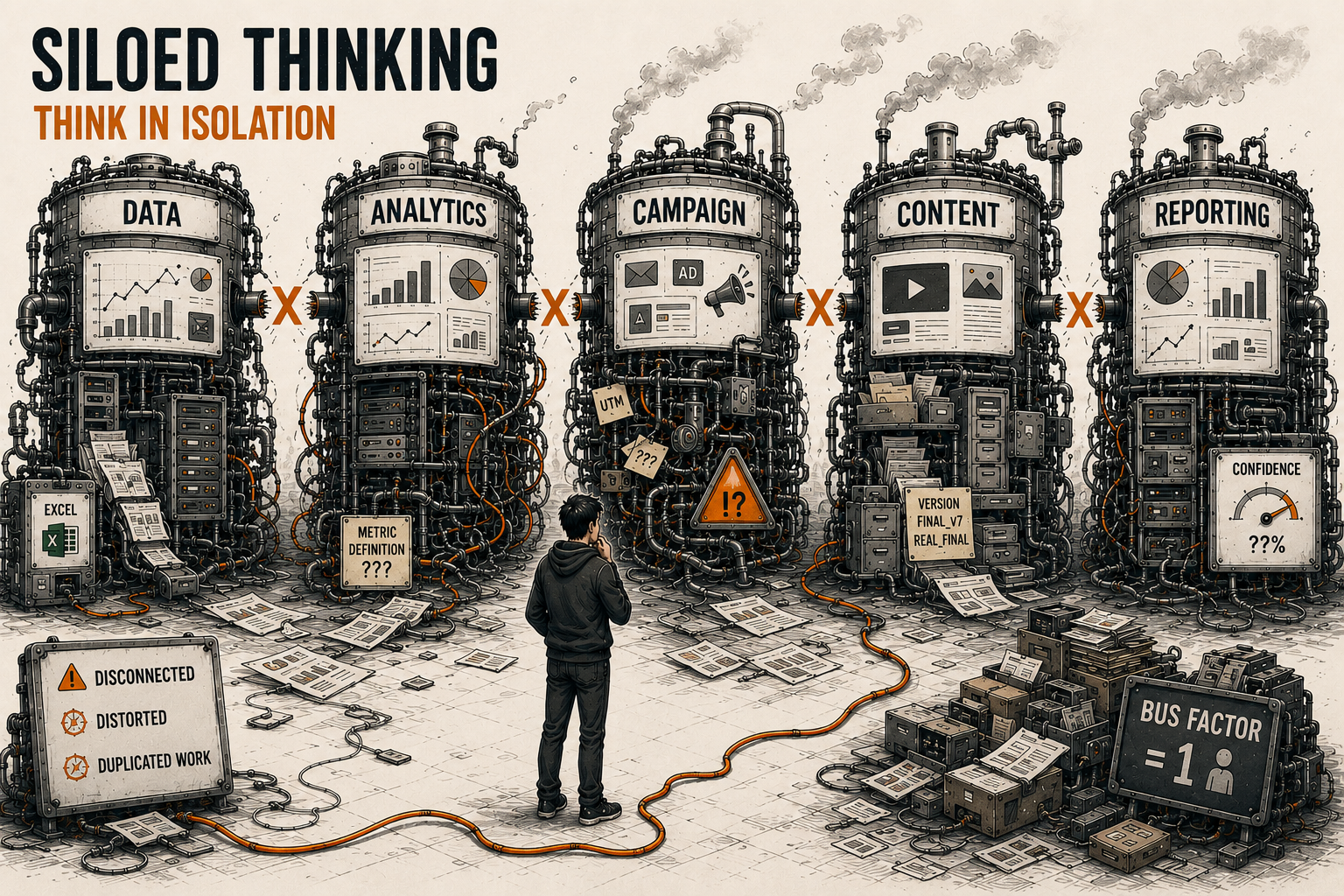
At the team level, siloed thinking shows up in process and knowledge management. For many reasons, quite a few managers do not want to, or are not able to, systemize how the team operates. A real version I have met: a marketing team’s entire analysis process tucked inside one staffer’s personal AI account, security risk and continuity risk bundled in one place. Or the reverse failure: the team has someone capable of building a sustainable tool stack and data flow, but there is no training roadmap, so the bottleneck remains even after the system is built.
And this is where AI enters: systematic thinking and AI leverage form a loop that spins both ways. People who think in systems give AI structure, so every output can be verified and reused, and the leverage compounds. People who think in silos use AI task by task, every question restarts from zero, and the tokens just keep burning. MIT estimates that 95% of enterprise GenAI projects produce no measurable ROI, and the culprit is not the models, but processes that are not systematic enough to hold the leverage.
How do you grow sustainably through the chaos?
The three observations share one root: we are buying output instead of building capability. You can buy tools, buy reports, even buy AI agents. But the ability to know whether a number is right or wrong is not for sale. So the principle I follow is very short: hire AI to do the work, do not borrow knowledge from AI. Concretely, across 3 layers:

Layer 1, the individual: build the verify habit and repay your knowledge debt.
- Feed AI real data and lock the method before letting it run; make AI show its work: the queries, the formulas, the source list. Any number that cannot be traced back to the source data is a red flag.
- Let AIs cross-check each other (hand one AI’s output to another AI to re-check the logic, recompute the numbers, click through the citations) and still spot-check the 3 to 5 most important numbers yourself. KPMG collapsed at exactly the step where nobody clicked the links.
- Keep a “knowledge debt register”: the list of things you are using but do not yet understand, and clear one item a week. Learn SQL through the very queries AI writes, learn how metrics are defined, learn basic statistics.
- Standardize before you automate, because automation applied to an efficient operation magnifies the efficiency, and applied to a messy one it magnifies the mess.
Layer 2, the team: manage the “bus factor” of knowledge. The bus factor is the number of people whose sudden absence makes a process collapse. Count how many of your team’s processes only one person can run, then repay the debt gradually: every analysis needs to ship with a method note, reports get cross-reviewed, ownership of recurring reports rotates, and once a quarter run a “bus drill” that assumes one person is away for 2 weeks. The goal at this layer: every critical process can be run by 2 to 3 people.
Layer 3, AI investment: allocate by the 10-20-70 rule. BCG distilled it from AI projects at scale: value comes 10% from algorithms, 20% from technology and data, and 70% from people and process. Buying AI tools for marketing and handing out licenses only covers the 10-20. The 70 is a shared method library with verify steps built in, a team workspace instead of personal accounts, and spend limits with monitoring.
These 3 layers are the first silhouette of the journey this series will walk with you: Foundation → Structured thinking → AI leverage to build Marketing Intelligence capability.
Frequently asked questions
What are the risks of using AI in marketing?
The three biggest risks are not in the models but in how they are used: knowledge debt (using AI in place of expertise you never built), double hallucination (being unable to verify the output) and amplified siloed thinking (every silo producing its own “truth” faster).
What is AI hallucination in marketing analytics?
It is the phenomenon of AI confidently producing numbers, citations or conclusions that do not exist inside analytical reports. The danger doubles when users lack the foundation to verify and go on to interpret those fabricated numbers into insights (double hallucination).
What does “knowledge debt” from AI mean?
It means using AI to fill the gap of an expertise you never built, similar to technical debt in software: it solves the immediate task, but the debt stays, and the interest compounds through cost, risk and dependency.
How do you build a trustworthy marketing analytics system when using AI?
Across 3 layers: individuals build the verify habit (lock the method, make AI show its work, spot-check); teams manage the bus factor (method notes, cross-reviews, 2 to 3 people per process); and investment follows the 10-20-70 rule, weighted toward people and process rather than tools alone.
Closing
Thank you for spending time with this returning issue of From Insights to Impacts. This piece has named the three diseases of the chaos; see you in the next issue, where I will go deeper into building a more sustainable Marketing Intelligence system amid the chaos: starting from the foundation, through structured thinking, to orchestrating AI.
📥 If you found this issue useful, subscribe to the Tuesday Brief so you do not miss the next one, and help me share this piece with fellow marketers so we can stay clear-eyed through the chaos together.
Read more on the site: Cheap data, expensive insights · Dashboard and report: effective use
Sources: KPMG pulls agentic AI report, 5/45 accurate citations (GPTZero, TechCrunch, The Register). EY withdraws report, 16/27 fabricated citations (Computing). MIT: 95% of GenAI projects show no measurable ROI (Fortune). Smartsheet: 40%+ of the work week on repetitive tasks (Smartsheet). UiPath: ~60% could save 6+ hours a week with automation (UiPath). BCG 10-20-70 (BCG, Forbes).