
Have you ever started a new course full of fire, only to feel the momentum fade after two weeks and quit completely within a month?
If so, you are not alone. I once had a friend, a very good Senior Marketer, who invested in an expensive data course (the kind that costs a month’s salary) to gain an edge in the agency world. She was thrilled in week one. By week two, face to face with statistical concepts and mathematical logic, her head started spinning. Within a month she had quit, tuition fully paid, gone back to her familiar old ways of working and labeled herself “not a numbers person, not a data person”.
I used to think the same about myself. I liked reading and writing, so I was a “words person”, and if data was ever needed, the analysts would handle it. But life sometimes throws you a lemon! A project landed on my desk that forced me to build a marketing dashboard from A to Z myself, because we could not wait 3 to 6 months to recruit and train a new hire who understood our business. So I had to learn while doing, starting with the crudest possible outputs and layering skills on as the work demanded them.
After 4 years of persistence, this “numbers-averse” marketer got comfortable with the common data tools and skills (SQL, Python, Power BI, Google Cloud) and built a complete data system with my team. Looking back, what got me past the barrier was not IQ or talent. I was lucky enough to stumble into a completely different way of thinking about learning: Agile Learning. Learn just enough to do, improve continuously and, most importantly, never quit halfway.
In the previous issue, I wrote about the 4 pillars of data-driven capability, where Mindset and Skills are the two cheapest and most important foundation pillars. This issue answers the question I left open: how does a marketer from a purely non-technical background learn data & AI without burning out and quitting halfway?
📌 Key Takeaways
- Most of us quit when learning a new skill not because we lack materials or aptitude, but because we learn the traditional Waterfall way: trying to load 100% of the theory before doing 1% of real work.
- Agile Learning flips that mindset: learn just enough to start, execute immediately to get feedback, then improve continuously through very short loops.
- Stage 1 (MVK): learn only the 20% of core knowledge that produces real results. To find that 20%, ask practitioners in the field and ask AI.
- Stage 2 (Build – Measure – Learn): apply the 20% you learned to one real piece of work, with the motto “done matters more than perfect”. Then measure the outcome and take in real feedback to improve. Every small loop that succeeds is a “Quick Win” that feeds the motivation to keep going.
- Stage 3 (Refactoring): evolve from improviser to expert by going back to “pay off the technical debt” from Stage 2. Learning the underlying principles is the priority here, and it is no longer hard, because you build on existing knowledge and real experience.
- Stage 4 (AI-Augmented): with the new connection standard (MCP), AI can now read your live data directly and review your actual work, instead of teaching generic theory. That makes AI a powerful assistant for accelerating your learning.
Why do we quit so easily when learning something new?
From what I have observed, most mid-course dropouts happen because people want to learn “properly”: wait until the foundations feel solid before daring to practice. And the data confirms the exact “fade point” from the opening of this article: an analysis of the journeys of more than 1 million learners across 16 online courses from the University of Pennsylvania found that engagement drops most sharply within the first 1 to 2 weeks, and very few make it to the end [1]. More broadly, the median completion rate of online courses is only about 12.6% [2]. In other words, quitting early when learning a new skill is extremely common, and it rarely comes down to a lack of intelligence.
The problem with the traditional Waterfall model of learning, at least for highly practical skills like marketing intelligence, is that it runs against how the human brain naturally learns, which produces three system errors:
1. Cognitive Overload. The human brain is not a hard drive that can download and store an entire body of knowledge mechanically. That is not a figure of speech but a well-researched biological limit. John Sweller’s Cognitive Load Theory shows that when the information to process exceeds the capacity of working memory, learning simply stops [3]. And that capacity is surprisingly small: Nelson Cowan’s research suggests we can only handle about 4 chunks of information at once [3]. The irony is that beginners are the most easily overloaded, because they do not yet have a mental “schema” to group new knowledge into larger chunks. In other words, the newer you are to a topic, the less you should learn per sitting, not more.
2. No feedback loop. Neurologically, the human brain learns remarkably well from reward prediction error. Every time we make a prediction, act on it and get a result that differs from what we expected (whether better or worse), that is when we remember the lesson most deeply. The brain treats what was just learned as a reward and releases dopamine, the excitement that keeps us coming back for more. Wolfram Schultz’s research on dopamine reward prediction error shows that dopamine cells respond most strongly to the gap between what we predicted and what actually happened [4].
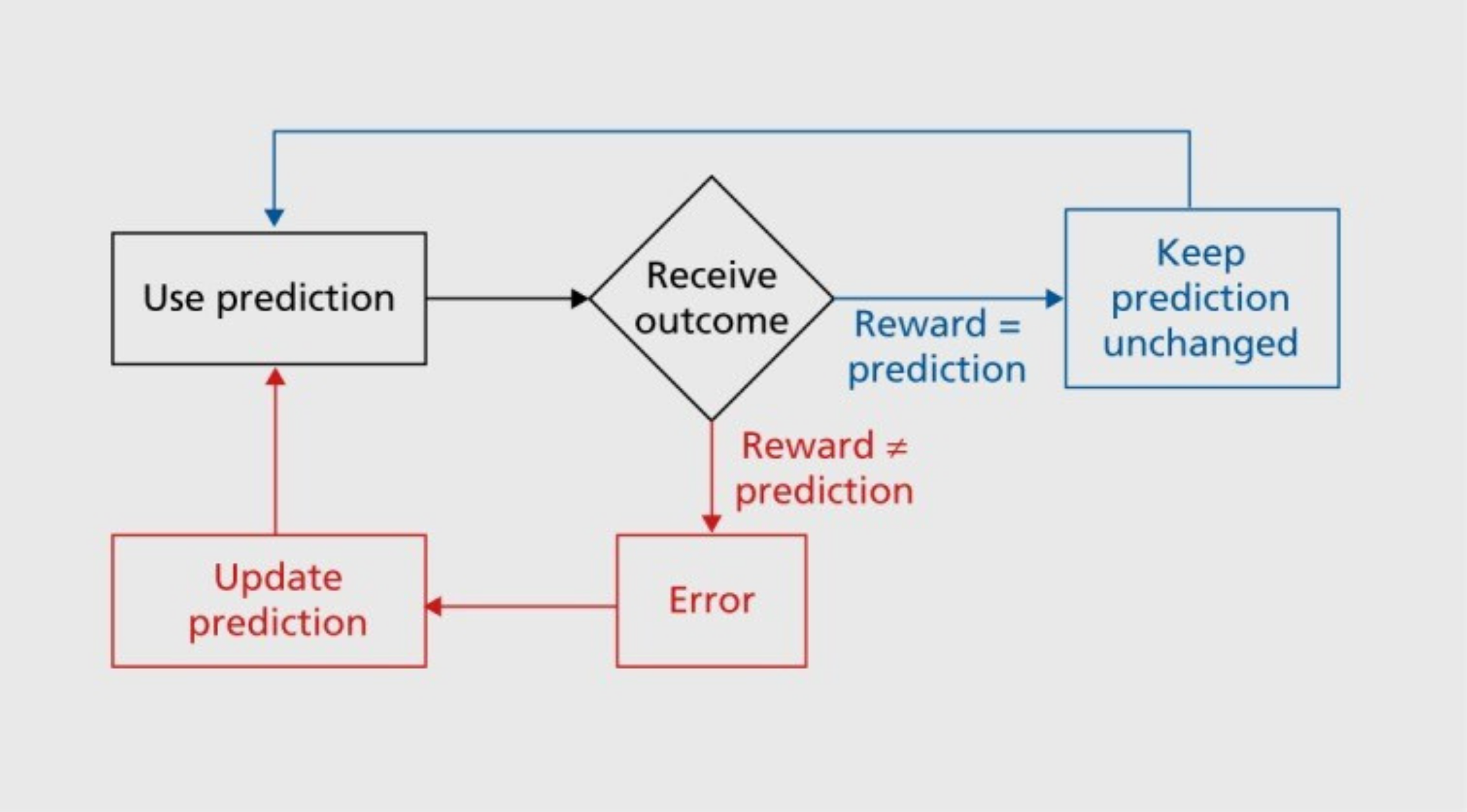
Linear Waterfall learning, however, looks a lot like Machine Learning’s training regime: it demands a huge volume of data upfront, but gives the learner no feedback loops to trigger the positive dopamine that sustains learning. So people stall.
3. Value latency. In the AI era, knowledge and best practices change by the week. If you spend six months to a year studying before creating your first bit of value, much of what you learned may already be obsolete. Worse, most of it will have evaporated from memory before you ever use it: a 2015 study by Murre and Dros replicated Ebbinghaus’s classic forgetting curve experiment and confirmed that we retain only about 27% to 33% of what we learn after 24 hours without reinforcement [5].
And this is not just a laboratory result. A study published at ACM SIGKDD 2022 analyzed 220 million memorization behavior logs from real learners on a language-learning platform and showed that memory decays along a predictable law, and that each well-timed review meaningfully extends the “lifespan” of that knowledge [5]. Even more relevant for career changers: an analysis of 4.28 million learning data points found that the more complex and abstract the content, the faster it is forgotten [5]. In other words, the difficult technical concepts you try to cram upfront are precisely the ones that evaporate first. Learning now to use months later means paying money and time for something that will vaporize on its own.
What is Agile Learning and how is it different from traditional learning?
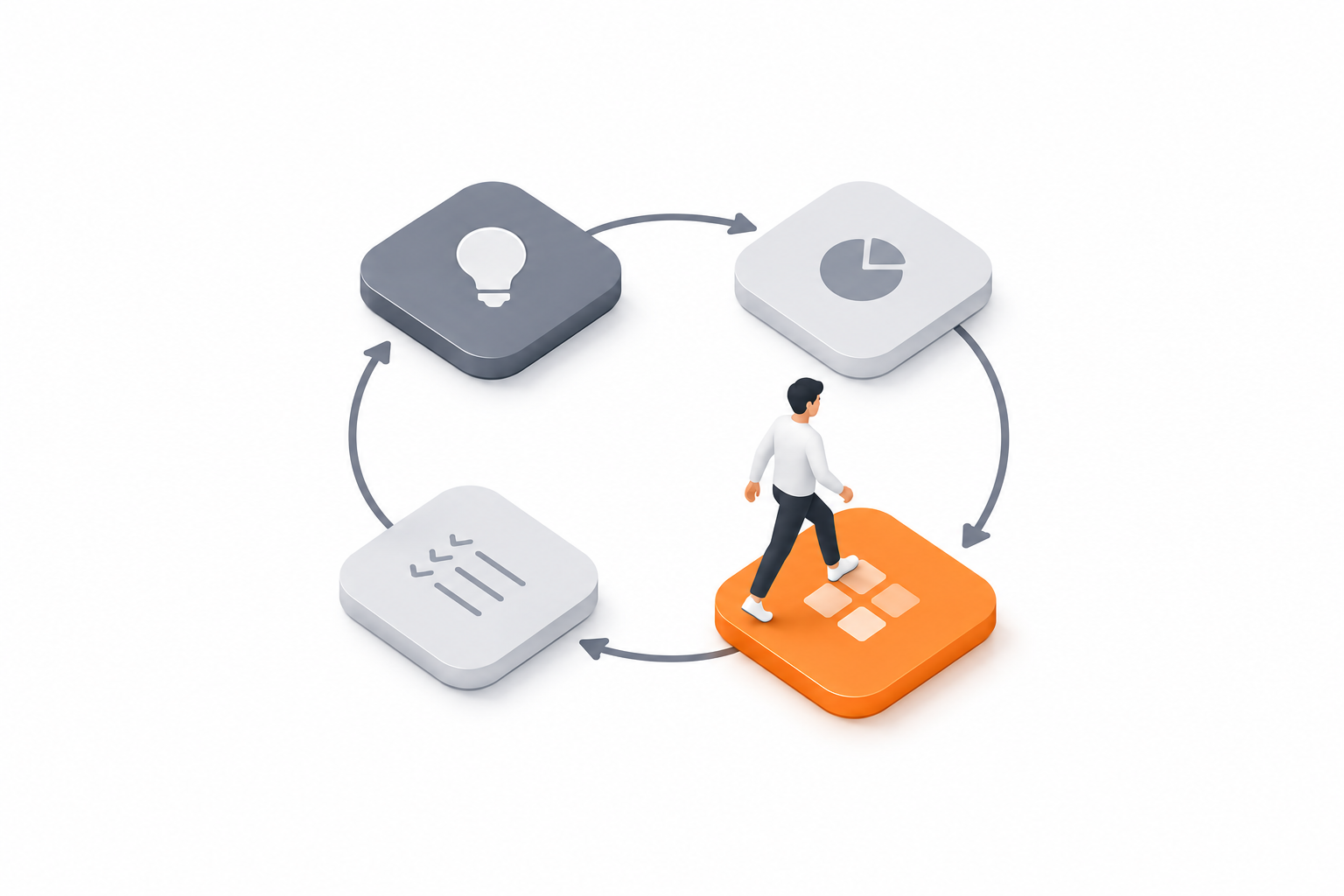
Agile Learning is a learning method that borrows its thinking from Agile Development in software: instead of building the complete thing in one pass, teams split a project into short loops (Sprints), continuously shipping a working version to collect feedback and optimize immediately. Applied to learning, it changes the goal from “learn to know everything” to “learn to solve problems through very short execution loops”. Learn just enough to do, improve continuously and, above all, do not quit halfway.
One thing I want to stress: this is not a new “trend”. It stands on decades of learning research.
- Kolb’s experiential learning cycle: David Kolb (1984) described learning as a four-step loop: concrete experience → observation and reflection → concept formation → renewed experimentation [6]. Look closely and this is almost exactly Build – Measure – Learn under a different name. Kolb’s core point: experience is the starting point of learning, not the end point.
- The 70:20:10 model: research by McCall, Lombardo and Eichinger (1996) at the Center for Creative Leadership suggests roughly 70% of real capability comes from work experience, 20% from other people and only 10% from formal training [7]. To be fair and precise: later studies debate the exact ratio (some arrive at something closer to 55:25:20) [7], so treat it as directional, not a hard formula. But the order of magnitude is remarkably consistent: courses are the smallest slice, and real work is where capability actually forms.
- The “just-in-time” principle: the most effective training interventions are the ones that deliver information right before a real task, paired with practice, immediate feedback and time to reflect afterwards [6]. This is exactly why “learn when needed” beats “learn for later”.
The method has 4 stages. You do not need to nail each one perfectly, just complete the loop and repeat.
Stage 1: MVK (Minimum Viable Knowledge), the least you need to start
MVK borrows directly from the MVP (Minimum Viable Product) mindset in tech. If startups use an MVP to ship the simplest version of a product and measure market response, you use MVK to filter out the 20% of core skills that produce real results fastest.
But when you are learning a new skill in an unfamiliar field, how do you know which 20% is core in a forest of knowledge? I suggest two sources:
- Ask practitioners: find someone who works with the skill you want to learn every day and ask them: “In your daily work, which 3 to 5 skills or tools take up 80% of your time?”. Want to learn SQL? Ask a data analyst which basic SQL commands they use every day. The answer will very likely be just the
SELECT,GROUP BY,WHERE,JOIN,HAVINGgroup plus the AGGREGATION group (SUM,COUNT,AVG,…) - Ask AI: instead of asking AI for a complete, detailed curriculum, describe your need and ask it to suggest the 3 most important tools or skills to start with. Say you are a traditional content writer who wants to make videos for your own TikTok channel. Try asking: “I’m a content writer and I want to turn a blog post into a 60-second TikTok video using my phone. Sketch a basic 3-step path with tools?”.
I still remember the first time a Python script of mine ran successfully, automatically backing up data from our warehouse to Google Cloud Storage. The code looked “dirty” beyond belief, but watching it run, and the data back itself up every single day, genuinely thrilled me: I had just freed myself from one repetitive manual task. That small joy fueled the motivation to learn the more advanced parts and clean the code up. Most importantly, MVK got me past the mentality of waiting to be perfectly ready before daring to start.
Stage 2: Build – Measure – Learn, done matters more than perfect
If Stage 1 frees you from the inertia of preparing, Stage 2 is where the skill actually forms. This is where Sprint thinking applies: instead of spending 3 months preparing for one grand project, spend 3 days producing a version that runs. You never get good before doing the work. You only get good while doing it. The stage has three steps, exactly as the name says:
- Build: use your Stage 1 MVK to create one small real product. If you are learning Automation, set up one simple flow that standardizes or processes data you have been handling manually.
- Measure: put that product into real use and look at what comes back. Did the AI summary actually capture the point? Did the automation flow break on formatting? This is where you measure real effectiveness instead of guessing.
- Learn: those stumbles show you exactly where your gaps are. If your prompt returns generic mush, you know you need to learn Context Injection. If the automation stops midway, you know you need to learn Logic Filters.
A real example: a marketer wants to learn Marketing Automation. Instead of finishing a full HubSpot certification first, she uses her MVK right away to connect Facebook Lead Ads to email through Zapier (Build). On the very first run, she notices customer names arriving stripped of their Vietnamese diacritics (Measure). So she zeroes in on the Formatter function to fix exactly that (Learn). Within a few hours she has a system delivering real value to the company.
Biologically, every loop that ends in even a small success creates a “Quick Win”, releasing dopamine that makes the brain excited and more confident. Learning stops feeling like an endless cram session and starts feeling like a chain of small conquests.
And Quick Wins are not just “for fun”. Teresa Amabile and Steven Kramer (Harvard) analyzed more than 12,000 daily work diary entries from 238 people in creative teams and uncovered the Progress Principle: of everything that makes a good workday, the single most powerful factor is simply the sense of making progress in meaningful work, however small the step [8]. In other words, motivation is not something you need before you start. It is the reward you receive when you put in effort and notice yourself improving every day.
Stage 3: Refactoring, pay off the “technical debt” and stop being an improviser
Refactoring describes improving a system’s internal structure without changing its external behavior. In Agile Learning, this is when you go back and optimize the things you patched together in Stage 2. If Stage 2 was about making it run, Stage 3 is about making it run well, fast and reliably. You move from “knowing tricks” to owning the fundamentals.
When we move fast with MVK and Sprints, we accept shortcuts to get results now. That is borrowing time from the future, which practitioners call Technical Debt. If you never “repay” it by going back to study the underlying principles, the system you built on MVK will eventually buckle under load or shatter against a harder problem.
The beautiful thing about this stage is that knowledge comes to you on demand, which is called Pull-based Learning (as opposed to Push-based, where knowledge is shoved into your head before you need it). Here is a very natural progression:
- Level 1: you build marketing reports manually in Excel. You are carrying “automation debt”.
- Level 2: the data grows to 500,000 rows and Excel starts freezing. That pain “pulls” you into learning SQL for faster queries, or Power Query to standardize the data.
- Level 3: you want to forecast seasonal trends instead of only looking backwards. The need to learn Python or Regression arises naturally, because you know exactly which pain it solves.
Stage 4: AI-Augmented Learning, a 10x boost to your knowledge bandwidth
In Agile Learning, AI is the “jet fuel” that accelerates all three earlier stages: it helps you filter your MVK quickly, debug inside your Sprint loops and suggest better Refactoring options. A logic bug that once took days to track down now takes seconds. More importantly, it directly attacks the three system errors from the top of this article: AI reduces cognitive overload (it slices knowledge to fit your exact need), shortens the feedback loop (instant responses) and erases most of the value latency.
The notable leap: AI can now connect to your tools and your data
This is the biggest change of the past two years or so, and the part I think many marketers have not yet exploited. Previously, if you wanted AI to look at your report, you had to export a file and copy-paste numbers into a chat. The AI saw a static fragment of data, severed from the real system, so every suggestion stayed generic.
That has changed, thanks to an open connection standard called MCP (Model Context Protocol). Anthropic released MCP as an open, neutral standard that lets AI models connect directly to tools, databases and APIs without custom integrations for every pair [9]. By 2026 the standard is supported by the major vendors (Anthropic, OpenAI, Google, Microsoft), with an ecosystem of more than 1,000 connector servers [9]. In marketer language: AI can now “look” straight into your live data instead of reading the screenshots you paste in.
For marketing work, what can already be connected includes:
- Marketing data sources: GA4, Google Ads, HubSpot, Shopify, Klaviyo, Google Sheets and many other platforms through ready-made connectors [10]. Supermetrics, for instance, reports connecting more than 170 data sources to Claude, ChatGPT, Copilot and Gemini [10].
- Databases: PostgreSQL, MySQL, BigQuery, Snowflake, MongoDB through their respective MCP servers [9].
- The practical result: AI understands your data structure (schema), so it can query directly, pivot its analysis without you rebuilding tables and skip the export step entirely [10].
Why does this matter for learning, not just productivity? Because it upgrades AI from “a teacher of generic theory” to “a reviewer of your actual work”. You used to ask “what makes a good dashboard” and receive a lecture. Now you can ask:
“Look at my GA4 data structure and my orders table: where is the data model behind this report wrong or incomplete? Show me where I’m misreading my own data.”
That is the tightest feedback loop a self-learner has ever had: feedback grounded in your own work, almost instantly. The Build – Measure – Learn loop shrinks from days to minutes. If you are just starting, connect one source you use daily (GA4 or Google Sheets is the gentlest entry point) and use it for reading and asking questions only, at first.
Three safety principles when AI touches your data
The deeper the connection, the higher the price of an unverified mistake. In the first issue I wrote that AI does not cure data blindness, it accelerates it, and that is doubly true once AI has real access:
- Least privilege first: start with read-only access to exactly one source. Do not grant write or delete permissions until you clearly understand what the AI is doing.
- Be careful with customers’ personal data: before connecting any source containing personal information, check your internal policies and the applicable data protection regulations. If the goal is learning, sample or anonymized data is enough.
- Always verify the output: AI reading live data does not mean AI understands your business correctly. Cross-check a few key numbers through another method before trusting them, especially before they feed a decision.
The crux of Stage 4: let AI help you understand the nature of the problem, not just hand you results. That is how you avoid the dependency trap, and it is exactly the “augment, not replace” spirit from the previous issues.
Becoming an Agile Do-er: Learn, Try, Fail
We have traveled from the pain of cram-style learning, through MVK, execution loops and refactoring, to acceleration with AI. In an era where knowledge is being commoditized by AI, the only difference between you and everyone else is how fast you can turn theory into a working solution.
The biggest barrier was never a lack of materials. It is the fear of being wrong. We fear the first video getting mocked, the first line of code failing, the first AI prompt returning something silly. But in Agile thinking, every mistake is a unit of data. There are no “failures”, only “feedback”. If you do not dare to be wrong early, you never get the chance to correct course. The people leading the market are rarely the smartest or the most credentialed. They are the ones who run the most experiments.
In short, the Agile Learner’s philosophy fits in three words:
Learn just enough to start (MVK). Try immediately to get real data (Build – Measure – Learn). Fail to find out exactly what to upgrade (Refactoring).
The greatest feeling of freedom is not knowing everything. It is knowing that you can learn anything by breaking it down and starting today.
A data analytics roadmap built for marketers (coming in August)
If you have read this far and the method makes sense, but you still do not know where exactly to start with data analytics, I have some news to share.
This August, I am releasing a pilot roadmap that helps marketers get started with data analytics. Three things I want to be clear about:
- Built specifically for marketers, not a trimmed-down version of a course for technical people. The starting point is the marketing work you already do every day.
- Built exactly on the Agile Learning method in this article: start from an MVK, move through Build – Measure – Learn loops with a real product, then refactor to level up. You will have usable results before you have to understand all the theory.
- It is a first pilot version. I want to send it to people who genuinely need it and are willing to give me feedback to improve it, rather than blasting it out wide. You could say the roadmap itself is running its own Build – Measure – Learn loop.
I will not promise you become a data expert in a few weeks. But I believe this roadmap gets you to your first Quick Win fast enough that you do not quit, and that is the thing that decides everything.
Receive the full version first, as soon as it ships.
A data analytics roadmap built for marketers
Fill in your details below to get the full version as soon as it ships in August.
FAQ
What is Agile Learning?
A learning method that borrows its thinking from Agile Development: instead of finishing all the theory before doing, you learn just enough to start (MVK), execute immediately to get feedback, then improve continuously through short loops. The focus is “learning to solve problems”, not “learning to know everything”.
What is MVK (Minimum Viable Knowledge)?
The minimum amount of knowledge, roughly the core 20%, that is enough for you to produce a first real result. You find it by asking practitioners “which 3 skills take up 80% of your time” and asking AI to suggest the few most important steps to start.
Can I learn data this way without a technical background?
Yes. I am a “words person” myself, numbers-averse, and I learned SQL, Python and Power BI exactly this way. The secret is not talent. It is breaking the goal down and always attaching the learning to a real product you currently need to build.
Will AI make me lazy and dependent?
Yes, if you only take the results. No, if you ask AI to explain the underlying logic and reasons. Use AI as a tutor and collaborator to understand problems faster, while the questioning, verifying and deciding stay with you.
Is connecting AI directly to marketing data complicated?
Not as complicated as it used to be, thanks to the open MCP standard (Model Context Protocol) and ready-made connectors for GA4, Google Ads, HubSpot, Shopify or Google Sheets. My advice: connect only one source you use daily, keep it read-only and always check personal data policies before connecting sources containing customer information.
Where should I start if I am too busy?
Pick exactly one real task that is currently costing you the most time, then learn just the MVK to solve it within hours to days. One small Quick Win feeds the motivation for the next loop, and that works far better than signing up for a long course and abandoning it.
If you find content like this useful, subscribe to the Tuesday Brief to get each full issue first.
📥 Subscribe to the Tuesday Brief to build your Marketing Intelligence capability with me, and stay clear-eyed through the chaos.
Sources
- Perna, L. et al. / Penn GSE, “Few MOOC Users Persist to Course End” (analysis of more than 1 million users across 16 University of Pennsylvania Coursera courses). Source
- “Uncovering MOOC Completion: A Comparative Study of Completion Rates from Different Perspectives”, Open Praxis (analysis of 221 MOOCs, median completion rate 12.6%). Source
- Sweller, J., Cognitive Load Theory (1988) and Cowan, N. on the limits of working memory (~4 chunks). Overview: NSW Department of Education. Source
- Schultz, W. (2016), “Dopamine reward prediction error coding”, Dialogues in Clinical Neuroscience 18(1). Source
- On the forgetting curve, three complementary sources: Murre, J. M. J. & Dros, J. (2015), “Replication and Analysis of Ebbinghaus’ Forgetting Curve”, PLOS ONE (a modern replication of the original 1885 experiment, using nonsense syllables under lab conditions, so the 27-33% figure illustrates the law) [link] · Ye, J., Su, J. & Cao, Y. (2022), “A Stochastic Shortest Path Algorithm for Optimizing Spaced Repetition Scheduling”, ACM SIGKDD, a memory model built from 220 million real memorization behavior logs [link] · Zaidi, A. et al. (2020), “Adaptive Forgetting Curves for Spaced Repetition Language Learning”, AIED, analysis of 4.28 million learner data points from Duolingo [link]
- Kolb, D. A. (1984), Experiential Learning and research on workplace learning. Source
- McCall, M., Lombardo, M. & Eichinger, R. (1996), the 70:20:10 model (Center for Creative Leadership). Note: later studies debate the exact ratio (some arrive at roughly 55:25:20), so treat it as directional. Overview
- Amabile, T. & Kramer, S. (2011), The Progress Principle (analysis of more than 12,000 daily work diary entries from 238 people). HBR summary
- Model Context Protocol (MCP), the open standard released by Anthropic for connecting AI to tools, databases and APIs. 2026 ecosystem overview
- Marketing data connectors for AI (GA4, Google Ads, HubSpot, Shopify, Klaviyo, Google Sheets): Supermetrics, 170+ sources to Claude, ChatGPT, Copilot, Gemini. Source
Read more on the site: The 4 pillars of a data-driven marketing team · 5 data thinking traps for marketers · AI in Marketing: The Age of Chaos