In the previous issue, “AI in Marketing: The Age of Chaos”, I named the three big challenges facing marketing today: high-interest knowledge debt from AI, double hallucination and siloed thinking. In this issue, I share the lessons and observations I have collected on building a sustainable Marketing Intelligence system: the foundation that lets a marketing team actually resolve all three challenges, instead of only treating the surface.
📌 Key Takeaways
- Data-driven marketing “in name only” fails not because of missing tools, but because of a missing human foundation (mindset, skills, process).
- Pillar 1 (Data mindset): data is not just the quantitative numbers on a dashboard. It also includes qualitative data: observations, experiences, customer feedback. Fixing the mindset is the cheapest step with the highest leverage.
- Pillar 2 (Skills): tier your people into Data Consumers and Data Specialists to upskill fast and cost-effectively.
- Pillar 3 (Infrastructure): without a Single Source of Truth, any analysis can be invalidated. You need Data Governance, a Data Warehouse and a right-sized tool ecosystem.
- Pillar 4 (AI): an accelerator, not a replacement. Do not chase AI before the three foundation pillars are up (McKinsey’s 10-20-70 rule).
What does genuinely data-driven marketing take?
A few months ago at a meet-up, a friend asked me:
“Hey Luu, my team built this dashboard that looks seriously cool. After the initial wow wore off, it hasn’t helped us make a single decision. We glance at the numbers, see the overall results, and that’s it. The rest is… pretty useless. What’s going on?”
I was surprised, not because it was strange but because it was so familiar! I used to think this was a problem specific to Vietnam as a still-developing market. It turns out his business runs in mature markets like Singapore, Europe, New Zealand and Australia, and the same thing happens there. So the “beautiful but useless dashboard” is not any one market’s problem. It is the common result of installing tools while skipping the foundation.
Looking back at nearly 4 years of studying and practicing data analytics in marketing, in both academic and business settings, here is what I have distilled: to build a marketing department that is data-driven in substance, you need all four of the following pillars (though not necessarily built all at once):
Mindset → Skills → Infrastructure & Tools → and only then AI.
The order is not random. It is the detailed version of the 10-20-70 rule McKinsey often cites for AI investment: only about 10% of AI’s value comes from algorithms and 20% from technology and data, while 70% comes from people and process. Skip that 70% and you get a machine that runs very fast, possibly in the wrong direction.
Pillar 1: The right mindset about data
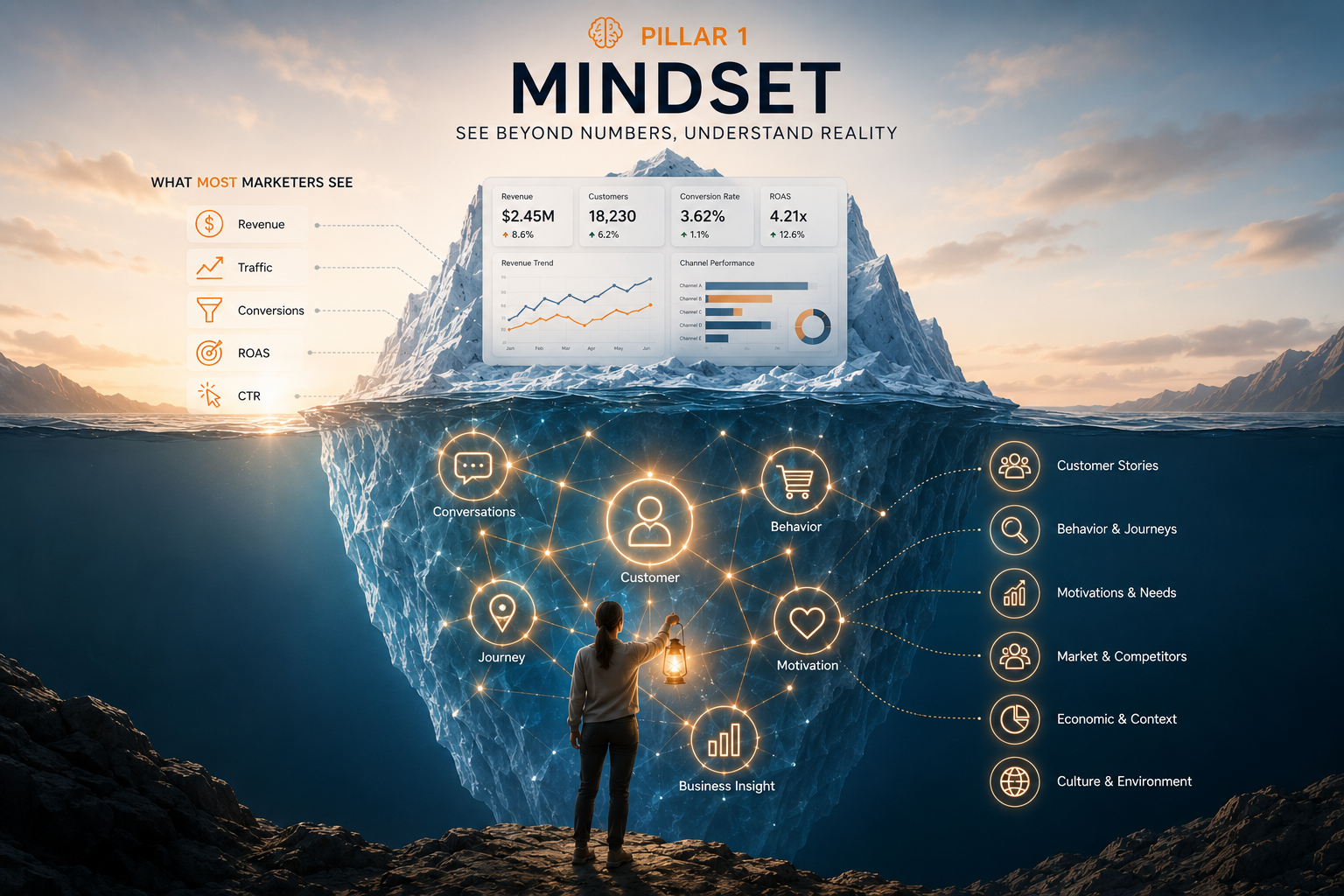
A while back I had a rather lively “debate” on LinkedIn with a CMO. He had written a long and fairly viral post, roughly titled “numbers crush insights”: that a data-obsessed approach does not fit creative functions like marketing, because creative work needs “observation and feeling”, needs the “emotional elements” of customers that cannot be measured, and only those produce insights that truly resonate. Crucially, to him, data meant the numbers on a dashboard: KPIs, clicks, impressions… and focusing on those gets you nowhere.
I half agree. Good marketing does need observation, reflection and very human emotion. If all you do is count funnel metrics (impressions, clicks, orders, revenue), you will struggle to see the “emotional touchpoints” that make content distinctive enough to convert.
However, I could see he was caught in a very common misconception:
“Data is just numbers, especially the numbers on a dashboard for tracking KPIs and targets.”
In reality, data is qualitative and quantitative, structured and unstructured. Those very observations, experiences and feelings are themselves a form of data, or the raw material for forming a hypothesis to test and analyze more deeply. Only when marketers escape this mindset trap do they stop using “creativity” or “vague insights” as a shield to avoid data, and stop dodging the pressure to change when “the data says so”.
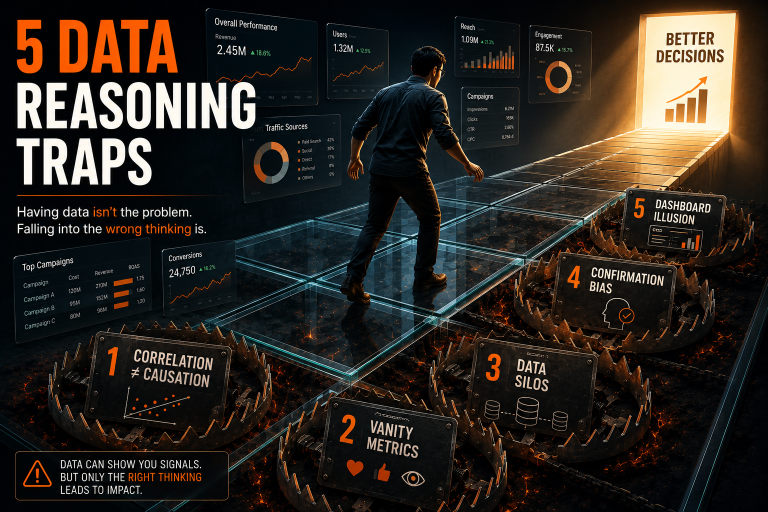
Beyond that, marketers commonly fall into 5 thinking traps that make data analysis performative rather than substantive:
- Confusing correlation and causation
- Obsessing over vanity metrics
- Analysis disconnected from decisions
- Confirmation bias
- Equating data analysis with data visualization
You can read the details of these 5 thinking traps, and how to avoid them, in “Why Marketing Fails at Data Analytics”.
Quick recap: getting the mindset right is what makes those “beautiful” dashboards useful, because that is when marketers stop admiring the numbers and start understanding and questioning them.
Pillar 2: Knowledge and skills
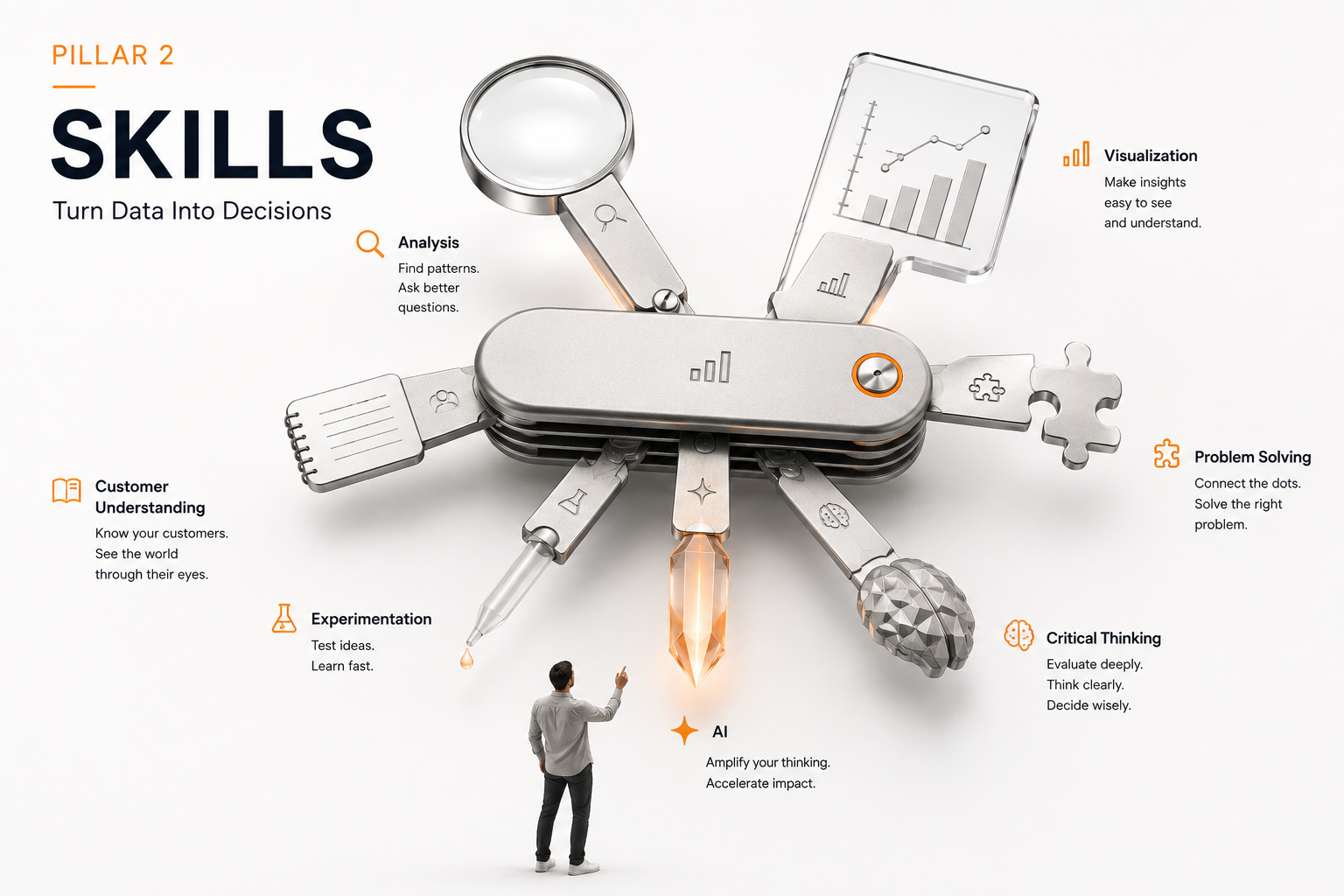
Speed of analysis and decision-making is the key factor that pushes data-driven work beyond “box-ticking” and makes it genuinely useful to marketers and their teams. To get that speed, a marketing department needs more than the ability to read reports and spot insights. It needs enough capability for self-report and self-analysis: the team can retrieve, process, analyze and model data on its own to dig deeper, instead of waiting around with a pre-built dashboard. That takes three core skill groups:
- Marketing Domain Expertise: this one is obvious, so I will keep it short. Without understanding the customer journey, the conversion funnel or segmentation, it is very hard to develop hypotheses, and hypotheses are where analysis starts to pay off.
- Problem Solving: using structured thinking to break a big problem into smaller parts, find the crux, then develop solutions and experiments. Here, the MECE principle (Mutually Exclusive, Collectively Exhaustive) combined with the Logic Tree gives you a basic framework to decompose problems without missing potential causes. (Two accessible books to start with: Problem Solving 101 and Bulletproof Problem Solving.)
- Data Stack Skills: covering processing techniques (SQL and basic Python to query, process, model and automate; if you use Power BI, add Power Query and DAX) and data visualization, which at its core is storytelling with data (Data Storytelling) through Looker Studio, Tableau or Power BI.
The crucial point, however, is that not everyone on the marketing team needs to learn everything. That would waste time and money, the team would never use it all, and not everyone is suited to data work. In my experience, the optimal approach is to tier your people by how they use data:
| Group | Who they are | Skills to focus on | Resourcing |
|---|---|---|---|
| Data Consumers | The majority, who constantly raise questions and use data that has already been processed | Domain + Problem Solving, plus reading reports correctly, asking the right questions of data, basic data processing and visualization skills | Can be trained immediately from current internal staff |
| Data Specialists | The minority, who process, model and build more complex reports | Problem Solving + the full Data Stack Skills | Train a few internal members or combine with external resources |
For the Data Specialists group, teams usually face a choice: train internally or hire an agency or freelancers. In my assessment, depending entirely on external resources is risky and inflexible, since the bottleneck remains, and outsiders can never understand your culture and team the way in-house people do. The optimal path is still to use external resources to set up a solid initial framework, then use in-house training to maintain and optimize. That way, you neither depend on outsiders forever nor fumble your way up from zero.
Pillar 3: Infrastructure and Tools, “a solid foundation before a tall house”

I have watched many teams send people off to study data analytics but never invest in matching tools, which wastes the investment in people. The problem usually shows up in three places.
- Data is not centralized: every time data is needed, someone pulls or exports it straight from the source, so data ends up scattered everywhere: Facebook Ads, Google Ads, the CRM, sales files from Shopee or TikTok Shop. These sources were never designed to connect to each other, so you only ever see one corner of the picture. Example: inside Facebook Ads, ad A drives more traffic and leads than ad B, but you cannot tell whether A actually brings in more real customers than B, because order data lives in a different system. At the same time, not centralizing data leads to the lack of a Single Source of Truth. When data is scattered and there is no shared standard for cleaning, processing and interpretation, every department ends up with its own “truth”. The result: arguments over “whose numbers are right” that invalidate even painstaking analysis.
- The data lock-in trap: all your clean data and reusable analytical models end up locked in a single place. This trap has several variants: Locked in a BI file (connecting Power BI or Tableau straight to the sources to process, model and build dashboards without a separate storage layer, so clean data and models are welded into one file); or Locked in a personal account or machine, especially in the AI era (data and even the entire analysis workflow get concentrated in one personal account, or one dedicated machine running AI for analysis; only one person, in one place, can touch it, the rest of the team depends on them, and the analytical knowledge disappears the moment they leave, exactly the “bus factor” I described in the previous issue).
To capture the full value of your data, and of the investment in mindset and skills above, a marketing team needs a data system with three components:
- Data Governance: the standard rules, processes and tools that ensure the security, quality and consistency of data.
- Data Warehouse: the place where all data from every source is centralized, processed and stored in a layered structure to become the Single Source of Truth, with permissions so multiple people can query and reuse it in parallel without touching the main data flows.
- A right-sized tool ecosystem: you do not need the most expensive or fanciest tools, you need a system that fits your needs. A small team can absolutely start with Google Sheets and Looker Studio, then move to BigQuery as the data grows.
Pillar 4: AI as the accelerator, not the replacement

Plenty of people tell me: “AI will replace the entire analytics function!”. I do not entirely disagree, but I have one important addition: AI makes working with data faster and easier; it does not remove the need for people who can ask the right questions.
Concretely, once the three foundation pillars are solid, AI helps:
- Data Consumers run more complex queries and processing without knowing how to code, or with just a little SQL.
- Data Specialists spend less time buried in code and more time building an “AI-ready” data system, so AI can work on the existing data safely and accurately.
- The whole team process qualitative data (customer feedback, comments, reviews on fanpages or Shopee) at scale, widening the scope of analysis and the odds of finding insight.
This is why “augment, not replace” is what is actually happening: AI handles the mechanical parts, pulling numbers, cleaning and repetitive reporting, while humans focus on the parts that need judgment: framing the right questions, interpreting ambiguous data and validating AI outputs against business reality.
The four pillars are an ecosystem, not a checklist
Building the first three pillars is precisely what creates an “AI-ready” data ecosystem, so AI genuinely multiplies marketing effectiveness instead of amplifying risk. The four pillars (Mindset, Skills, Infrastructure and AI) do not operate independently; they reinforce each other. Missing one, and your marketing machine limps. So do not rush after AI while the three foundation pillars are still not built.
You also do not need to pressure yourself into having all four pillars at once. The practical way is to pick the weakest pillar holding you back the most right now and start there. For most teams I meet, the cheapest and most effective starting point is always Pillars 1 and 2, before spending another dollar on tools or AI.
FAQ
What is data-driven marketing?
It is marketing in which decisions (from content and channels to budget and campaign optimization) are guided by data and analysis rather than gut feel alone. Importantly, “data” here includes both quantitative (numbers) and qualitative (observations, customer feedback), not just the metrics on a dashboard.
Where should a small marketing team with a limited budget start?
Start with Pillar 1 (Mindset) because it is nearly free, then Pillar 2 (Skills) for a few key people. On tools, Google Sheets plus Looker Studio will take you a very long way before you need a Data Warehouse.
Does the whole team need to learn SQL and Python?
No. Only the Data Specialists (the minority) need the full data stack skills. Data Consumers (the majority) only need to read reports correctly and ask the right questions of data.
Will AI replace analytics people?
In the near term, AI augments more than it replaces. It shoulders the mechanical work and speeds up analysis, but it still needs humans to ask the right questions and validate the results. Without the mindset and skills foundation, AI can make mistakes spread faster.
Invest in tools first or train people first?
People first. By the 10-20-70 rule, about 70% of the value comes from people and process. Buying tools before the team can use them is the fastest way to acquire another “decorative” dashboard.
Closing
In the next issue, I will share a special learning method that helped a “words person” like me get past the technical barriers to learn data. If you found this useful, subscribe to the Tuesday Brief to get the full issue first.
📥 Subscribe to the Tuesday Brief to build your Marketing Intelligence capability with me, and stay clear-eyed through the chaos.
Read more on the site: 5 data thinking traps for marketers · Dashboard and report: effective use · Cheap data, expensive insights